Many managers know they need to have a conversation but are unsure how to approach it, particularly when the situation feels sensitive or has been ongoing for some time.
Supporting difficult conversations is about helping you prepare for that discussion, so that it is clear, constructive, and focused on what needs to be resolved.
My work in this area is supported by a structured approach (RESOLVE), which provides a clear way of thinking through how to prepare for and handle these conversations.
RESOLVE: A way to addresses difficult issues
Without the skills and confidence, conversations are put off, postponed, ignored, or are hidden under the carpet. There are costs to the 'pretend it's not there' approach, which show up as worry, anxiety, loss of focus, and conversations that skirt round topics and are essentially pointless.
All of this saps energy and costs time and money

"Respectful communication under conflict or opposition is an essential and truly awe-inspiring ability"
Bryant McGill
When you know that you have the knowledge and skills to handle a difficult conversation, you approach the situation with quiet confidence and esteem.
It is this as much what you say and how you say it, that makes the difference.
The RESOLVE model recognises that the issue of managing difficult conversations requires:
-
specific communication skills
-
a degree of emotional intelligence
-
an understanding of the context in which the conversation has arisen
-
a working knowledge of the 'communication process'
RESOLVE serves two key principles:
-
to save businesses and organisations money
-
to maintain, and ultimately to improve, work-based relationships
RESOLVE is orientated around work-based scenarios where a problem or issue has arisen, a change is required, a person's behaviour is not as good as expected, or a working relationship is not as productive as it could be - either between two separate individuals (e.g., a manager and a member of staff) or two or more members of a team.
More specifically, RESOLVE helps address several themes that regularly crop up as the subject of a difficult conversation:
-
poor performance
-
irregular attendance
-
time of work due to excessive 'sickness'
-
a breakdown in working relationships with others
-
inappropriate behaviour and language
-
or as part of the informal stage of an internal disciplinary process
It is not orientated towards the delivery of 'bad' or unfortunate news, such as a trauma or bereavement - there are other models available that are more suitable for this particular circumstance.
Complex and difficult work-based conflicts can be resolved by formal investigations, mediation, or other structured processes such as tribunals or occasionally, through a judicial process. RESOLVE, as a concept, sits right at the start of these sorts of cases, well before they get out of hand: it offers the opportunity for managers at all levels to manage a difficult conversation in a fair, meaningful and robust way so that situations do not escalate to the point where a formal structured interventions are required.

12 hr online RESOLVE Mastery course
6 fortnightly sessions of 2 hours each. Making the best use of online technology, and incorporating a rich and diverse range of learning activities, the approach deliberately sets out to create a safe and trusting environment whire it is acceptable to take risks, which encourges practice and develops reflection skills, all of which are orientated around you developing the sound set of skills required to manage difficult conversations.
If you would like to find out more about the course, and how it will help you in your particular working context,
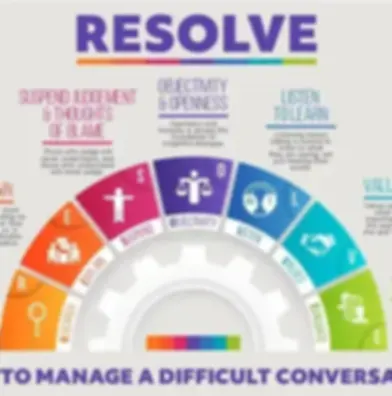
RESOLVE is an acronym which stands for:
R - Research: Do all aspects of the necessary homework and preparation first!
E - Explain: Within the meeting - how will the process work? It is wrong to assume others know and understand the process. Carried out well, it lays the foundation for success.
S - Suspend Judgement: You don't know what you don't know until you do. Start the process with a mindset that represents a blank piece of paper.
O - Open-minded: The presentation of different points of view WILL allow opinions to change in process. It leads to different levels of understanding. The key to success is to be open to receiving new information.
L - Listen: The need to recognise the difference between hearing and listening and the effect of active listening on the process - it is much misunderstood and undervalued.
V - Value: A difference in values is often at the root of disagreements. They need to be recognised and managed so that all people involved understand what is at stake and what needs to change in order to align the differences.
E - Evaluation: RESOLVE represents a process that starts before the difficult conversations take place, and extends well beyond its conclusion. However, at the end of the actual meeting, clarity about the 'next steps', and of the effectiveness of the process is paramount. Practitioners of RESOLVE sit comfortably in the process of continuous improvement and lifelong learning.
The outcome of the RESOLVE process, in the very best case, is an agreement from both sides of the discussion about what to do in order to solve a problem or move a situation forward. It is reached in an environment that is forward thinking, solution focused and professionally well structured.

12 hr online RESOLVE Mastery course
6 fortnightly sessions of 2 hours each. Making the best use of online technology, and incorporating a rich and diverse range of learning activities, the approach deliberately sets out to create a safe and trusting environment whire it is acceptable to take risks, which encourges practice and develops reflection skills, all of which are orientated around you developing the sound set of skills required to manage difficult conversations.
If you would like to find out more about the course, and how it will help you in your particular working context,